
AI Stock Crash 2026: Why Nvidia, AMD and Nasdaq Are Falling
I stocks crash in November 2026 as Nvidia, AMD and Nasdaq plunge. Discover the causes, AI bubble fears, data center risks and Wall Street outlook.

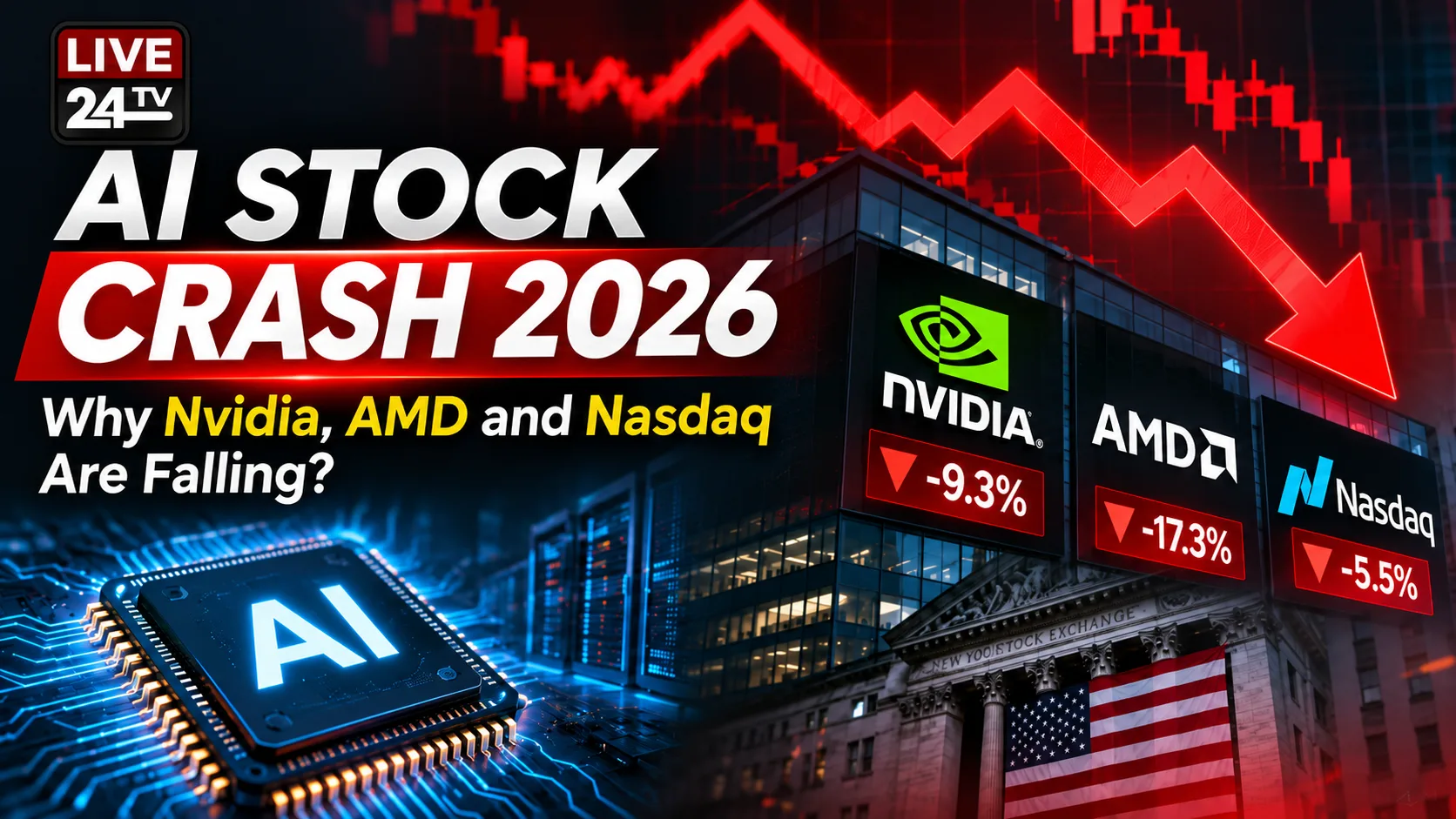
AI Stock Crash 2026: Why Nvidia, AMD and Nasdaq Are Falling as Wall Street Questions the AI Boom
LIVE 24 TV | Business & Technology
The artificial intelligence boom is facing one of its biggest financial challenges as Wall Street witnesses a massive technology stock sell-off. On November 5, 2026, the Nasdaq Composite plunged 5.5%, while Nvidia, AMD and other semiconductor companies suffered substantial losses. Approximately $2.5 trillion in market capitalization was wiped from the Nasdaq-100 as investors raised concerns about AI infrastructure spending, regulatory uncertainty, rising borrowing costs and the profitability of artificial intelligence investments. The dramatic market decline has revived a critical question: Is the AI stock crash merely a temporary correction, or are investors witnessing the beginning of an artificial intelligence investment bubble bursting?
AI Stock Crash 2026: What Happened on Wall Street?
The United States stock market experienced one of its most severe trading sessions in recent years on Thursday, November 5, 2026. A broad sell-off led by artificial intelligence and semiconductor companies pushed major Wall Street indexes sharply lower, erasing trillions of dollars in market value and increasing fears about the future of the technology investment boom.
The technology-heavy Nasdaq Composite declined approximately 5.5% to close at 24,315 points, placing the index nearly 12% below its October 6 record high. The S&P 500 dropped 4.4% to 7,353.73, marking its worst session since the April 2025 tariff-related market turmoil. Meanwhile, the Dow Jones Industrial Average fell approximately 1,833 points, or 3.4%, to close at 51,523.06.
The sell-off was especially intense among semiconductor manufacturers and companies associated with AI data center construction. The Philadelphia Semiconductor Index fell approximately 12%, reflecting growing investor concerns that the pace of AI infrastructure development could slow.
According to Reuters, the Nasdaq-100 lost approximately $2.5 trillion in market capitalization during the session. The scale of the decline illustrates how heavily global financial markets have become dependent on expectations surrounding artificial intelligence.
Although AI-related companies suffered some of the largest losses, the selling pressure extended into industrial, financial and other sectors. The widespread downturn suggested that investors were not simply reacting to disappointing company earnings but were reassessing broader economic and political risks.
Why Are AI Stocks Crashing in November 2026?
The primary reason behind the AI stock market crash is a combination of political uncertainty, expensive stock valuations, enormous infrastructure investment and concerns about whether artificial intelligence companies can generate sufficient profits.
For several years, investors have viewed artificial intelligence as a potentially transformative economic technology. Companies producing advanced processors, providing cloud computing infrastructure and developing AI software attracted extraordinary amounts of investment.
However, the financial markets are increasingly questioning whether the speed of investment has moved ahead of the industry's ability to generate sustainable earnings.
The immediate market decline followed the November 3 US midterm elections, which created uncertainty about future regulations affecting artificial intelligence infrastructure.
Investors also became concerned that tighter financing conditions and growing political opposition to data center projects could delay construction and reduce demand for the advanced semiconductor chips required to operate powerful AI systems.
These developments have forced Wall Street to reconsider the assumptions that previously supported high valuations for AI-related businesses.
US Midterm Elections Raise Concerns About AI Data Center Regulations
The outcome of the November 2026 US midterm elections emerged as one of the major triggers for the sudden market decline.
Democratic victories that resulted in control of both chambers of Congress increased investor expectations that the government could introduce tougher oversight of artificial intelligence infrastructure, particularly large data centers.
AI data centers consume substantial electricity and require specialized cooling systems, high-speed networking infrastructure and considerable physical space. Their rapid expansion has generated opposition in some American communities concerned about rising electricity prices, water consumption and environmental consequences.
Investors fear that additional regulatory scrutiny, lengthy approval procedures or restrictions on new construction could delay planned data center projects.
Such delays would have consequences beyond the companies operating the facilities. Semiconductor manufacturers, electricity infrastructure suppliers, construction companies and businesses providing specialized cooling equipment could also experience slower demand.
Reuters reported that UBS estimated approximately 30% of planned US data center capacity additions for 2028 could be at risk under certain regulatory and development constraints.
However, this estimate represents an assessment of potential risk rather than a confirmed cancellation of those projects.
The market's reaction therefore reflects uncertainty about the future regulatory environment, not evidence that a nationwide ban on AI data center construction has already been implemented.
Nvidia Stock Crash: Why the AI Chip Giant Fell
Nvidia became one of the most prominent companies affected by the November 5 technology sell-off.
Shares of the semiconductor giant declined approximately 9.3% as investors reassessed the future growth of the AI infrastructure industry.
Nvidia has played a central role in the global artificial intelligence revolution by supplying high-performance graphics processing units, or GPUs, used to train and operate advanced AI models.
Major cloud computing providers and AI developers rely on specialized processors to perform the complex mathematical calculations required for machine learning and generative artificial intelligence.
This demand has transformed Nvidia into one of the world's most influential technology companies.
Nevertheless, the company's close connection to AI infrastructure spending also makes its share price sensitive to expectations about future data center construction.
If large technology companies delay planned investments or reduce purchases of advanced processors, semiconductor revenue growth could slow.
Even the possibility of reduced demand can cause substantial stock price movements when investors have already priced in years of rapid earnings expansion.
The November 5 decline does not establish that Nvidia's underlying business has collapsed. Instead, it highlights how quickly market valuations can change when investors become less confident about future growth.
AMD Stock Decline Reflects Broader Semiconductor Market Pressure
Advanced Micro Devices, commonly known as AMD, suffered an even steeper fall than Nvidia during the trading session.
AMD shares dropped approximately 17.3%, making the company one of the major casualties of the semiconductor sector sell-off.
AMD has been investing heavily in advanced computing technology and AI accelerators as it competes for a larger share of the rapidly growing artificial intelligence hardware market.
The company is particularly exposed to investor expectations concerning demand for high-performance processors, data center equipment and enterprise computing systems.
When the outlook for AI infrastructure spending becomes uncertain, companies competing for future market share can experience significant valuation pressure.
The decline in AMD also demonstrated that investors were reducing exposure across the semiconductor sector rather than targeting a single company.
Other chip manufacturers, including Broadcom, Micron Technology and Marvell Technology, also came under heavy selling pressure.
The semiconductor industry's interconnected nature means concerns about data center investment can affect several companies simultaneously.
Big Tech's Massive AI Spending Creates Financial Questions
Another major reason behind the AI stock crash is the extraordinary amount of capital required to develop and operate artificial intelligence systems.
Technology companies such as Microsoft, Alphabet, Amazon and Meta have been investing heavily in advanced chips, data center facilities, electricity infrastructure and AI model development.
The construction of a modern AI data center requires extensive investment in servers, processors, networking hardware, cooling technology, property and reliable electricity supplies.
These projects can take years to develop and may require substantial expenditure before generating meaningful financial returns.
Although large technology companies often possess strong balance sheets and significant operating cash flow, the enormous scale of AI spending has increased scrutiny of capital allocation.
Investors are asking whether the additional revenue generated by AI products and services will eventually justify the cost of constructing the infrastructure needed to deliver them.
The most important financial concern is the relationship between capital expenditure and future cash flow.
A business can report rising revenue while simultaneously experiencing pressure on free cash flow because it continues investing heavily in infrastructure.
If spending expands faster than profitability, investors may become less willing to assign premium valuations to the company.
The market is therefore moving toward greater scrutiny of how efficiently technology companies can convert AI investment into earnings.
Artificial Intelligence Faces a Return-on-Investment Challenge
The AI industry's biggest long-term financial challenge is demonstrating a convincing return on investment.
Artificial intelligence is already being used in software development, financial analysis, customer service, scientific research, healthcare administration and business automation.
However, technological adoption does not always translate into immediate profitability.
Developing advanced AI models involves significant research, engineering and computational expenses. Operating these models also requires continuous access to expensive computing infrastructure.
Companies providing AI services must generate enough revenue to cover these costs while remaining competitive in a rapidly changing market.
Competition between AI developers may also limit pricing power, particularly when similar products become widely available.
This creates uncertainty about how much financial value the industry will ultimately capture.
A company may offer innovative AI services and attract millions of users while still struggling to generate sustainable profit margins.
Investors are now asking whether the commercial benefits of artificial intelligence can grow quickly enough to support the enormous amount of capital already committed to the sector.
This concern is central to the debate over whether AI-related stocks have become overvalued.
Rising Borrowing Costs Threaten AI Infrastructure Expansion
The financing requirements of artificial intelligence infrastructure have become another major source of investor anxiety.
Data center development involves expensive long-term projects that may depend on debt financing, partnerships and external capital.
Higher interest rates increase the cost of borrowing money to finance construction and equipment purchases.
Smaller AI infrastructure businesses may face particular difficulties because they lack the financial resources available to established technology giants.
When financing conditions tighten, lenders can become more selective and demand stronger evidence that projects will generate sufficient cash flow to repay their debts.
This creates a potential slowdown in infrastructure development.
Companies may postpone construction, reduce expansion plans or seek additional financing on less favorable terms.
A slowdown in data center development could subsequently affect demand for chips, specialized networking equipment and electricity infrastructure.
The November market decline reflected investor concerns that a combination of tighter financing conditions and political uncertainty could make the economics of AI expansion more difficult.
Are AI Stocks Overvalued in 2026?
The sharp decline has intensified debate about whether AI-related stock valuations became disconnected from realistic earnings expectations.
During periods of rapid technological innovation, investors frequently assign high valuations to businesses expected to benefit from future economic transformation.
Such valuations can be justified if companies eventually deliver exceptional earnings growth.
However, they also create substantial financial risk.
When a stock price assumes years of extraordinary performance, relatively small disappointments can produce dramatic declines.
Investors are increasingly examining whether AI companies can maintain revenue growth, protect profit margins and generate enough cash to support continued investment.
This reassessment does not necessarily mean that leading AI businesses are fundamentally weak.
A successful company can still be an expensive investment if its share price already reflects overly optimistic assumptions.
The November 2026 sell-off illustrates how quickly stock prices can fall when expectations change.
AI Bubble 2026: Could This Become Another Dot-Com Crash?
The market correction has revived comparisons with the dot-com bubble of the late 1990s and early 2000s.
During the internet investment boom, investors poured enormous amounts of money into businesses promising to transform communication, commerce and entertainment.
Many of those predictions about the internet's long-term importance ultimately proved correct.
Nevertheless, numerous companies failed, and investors suffered major financial losses when market valuations collapsed.
Artificial intelligence could create a similar distinction between technological success and investment returns.
AI may transform industries and improve productivity for decades, but this does not guarantee that every business associated with the technology will become profitable.
There are also significant differences between the two investment periods.
Several leading AI companies are established multinational technology businesses with substantial existing revenues, diversified operations and long customer relationships.
This makes the current environment different from the speculative internet startups that dominated parts of the dot-com boom.
However, the historical lesson remains relevant: revolutionary technologies can coexist with excessive market speculation.
The ultimate financial success of artificial intelligence will depend on the ability of companies to convert technological innovation into sustainable earnings.
AI Market Sell-Off Spreads Beyond the United States
The decline in American technology shares also created uncertainty across international financial markets.
Artificial intelligence depends on a globally interconnected supply chain involving semiconductor design, chip manufacturing, memory production, networking equipment and computing infrastructure.
Companies in Asia, Europe and North America participate in different stages of this supply chain.
South Korea's Kospi fell approximately 5.3% during the November 5 session as technology and semiconductor stocks faced significant selling pressure.
Other international markets also experienced volatility as investors evaluated the potential impact of slower AI infrastructure growth.
The global nature of the semiconductor industry means a slowdown in one part of the AI investment cycle can influence businesses operating in several countries.
For example, changes in demand for advanced chips can affect manufacturers of semiconductor equipment, memory components and specialized industrial machinery.
As global investors rebalance portfolios, volatility in major American technology shares can also influence capital flows to emerging markets.
What Does the AI Stock Crash Mean for India?
India is not isolated from developments in the global artificial intelligence market.
Indian technology businesses provide software development, IT services, engineering and digital transformation solutions to clients around the world.
Changes in international corporate technology budgets can therefore influence revenue opportunities for Indian IT companies.
If American businesses reduce spending on infrastructure or postpone major technology projects, some Indian service providers could experience delays in client decisions.
However, AI adoption may also create new business opportunities for Indian companies specializing in automation, cloud migration, cybersecurity and enterprise software integration.
The impact will depend on individual business models and customer demand.
A reduction in spending on AI hardware does not necessarily mean an equivalent reduction in demand for services that help companies use artificial intelligence more efficiently.
Investors in Indian technology stocks should therefore distinguish between companies dependent on large infrastructure projects and those benefiting from the broader commercial adoption of AI.
Does the Stock Market Crash Mean Artificial Intelligence Is Failing?
The decline in AI stock prices should not be confused with the failure of artificial intelligence technology.
Financial markets frequently experience sharp corrections even while underlying industries continue expanding.
Artificial intelligence remains an important area of technological research and commercial development.
Businesses are exploring AI applications to reduce operating costs, improve decision-making, automate repetitive tasks and develop new products.
However, the financial benefits of these applications may take longer to materialize than investors previously anticipated.
This creates an important distinction between technological potential and stock market valuation.
A company can develop valuable technology while its share price declines because investors previously expected even faster growth.
Similarly, the AI industry can continue advancing even if spending on some infrastructure projects slows.
The November 2026 correction therefore represents a significant reassessment of financial expectations, rather than proof that artificial intelligence has lost its usefulness.
What Happens Next to Nvidia, AMD and Other AI Stocks?
The future direction of AI-related stocks will depend heavily on corporate earnings, infrastructure spending plans, financing conditions and regulatory developments.
Investors will closely examine whether major technology companies continue increasing their purchases of advanced processors and expanding data center capacity.
Corporate financial results will also provide important evidence about the commercial profitability of AI services.
If leading companies demonstrate strong earnings growth and improving investment returns, market confidence could recover.
However, continued uncertainty about capital expenditure and infrastructure regulation may keep valuations under pressure.
The Federal Reserve's monetary policy will also influence borrowing conditions and investor appetite for growth-oriented companies.
A prolonged period of expensive financing could make infrastructure projects more difficult to justify financially.
Conversely, stronger profitability and improving financing conditions could support renewed investment in the sector.
There is no certainty that the current decline will develop into a prolonged bear market, just as there is no guarantee that technology shares will quickly recover.
Could the AI Stock Market Crash Become Worse?
Several risks could intensify the correction.
A larger-than-expected reduction in planned data center investment could weaken revenue expectations for semiconductor suppliers.
Additional regulatory restrictions or development delays could also increase uncertainty about future computing demand.
If major technology companies report disappointing AI-related revenue growth, investors may question whether current infrastructure investments are economically sustainable.
Financial stress among highly leveraged data center businesses could create additional pressure across the investment ecosystem.
On the other hand, strong corporate earnings, sustained demand for computing capacity and greater regulatory clarity could help stabilize the market.
The direction of the market will ultimately depend on how these competing factors develop.
For long-term investors, the most important issue is not simply whether stock prices have fallen, but whether the underlying businesses can support their valuations through sustainable earnings and cash generation.
Conclusion: The AI Revolution Continues, but Wall Street Demands Proof
The November 5, 2026 AI stock crash represents a significant turning point in global financial markets.
The Nasdaq's 5.5% decline, substantial losses in Nvidia and AMD, and the sharp fall in semiconductor shares demonstrate how quickly investors can reassess an industry that has attracted extraordinary enthusiasm.
Political uncertainty following the US midterm elections, fears of tighter data center regulation, massive infrastructure spending and rising financing costs have combined to challenge the financial assumptions supporting AI-related valuations.
Yet the stock market decline does not mean artificial intelligence has stopped transforming the global economy.
The technology continues to offer substantial opportunities across business, science, healthcare, manufacturing and digital services.
The central question is whether the companies building the AI economy can generate sufficient profits to justify the enormous investments required.
For years, investors rewarded businesses for promising to become leaders in artificial intelligence.
Now, Wall Street increasingly wants measurable results.

The AI revolution may be far from over, but the November 2026 stock market crash sends a powerful message: technological innovation alone is no longer enough. Investors want sustainable profits, realistic valuations and convincing evidence that the world's massive AI investment boom will ultimately pay off.
LIVE 24 TV | Global Business & Technology News
Website: www.live24tv.com
Follow us: @live24tv
AI Stock Crash 2026, Why AI Stocks Are Falling, Nvidia Stock Crash, AMD Stock Decline, Nasdaq Crash November 2026, AI Bubble, Artificial Intelligence Market, Wall Street Sell-Off, AI Data Center Regulations, Semiconductor Stocks, AI Investment Risks, Global Stock Market News.