
OpenAI Dots Explained: The New AI Agents Changing How We Work
OpenAI Dots is bringing a new idea to the AI industry: instead of using artificial intelligence only to answer questions, users can give AI an ongoing task and allow it to work on that task with connected tools.

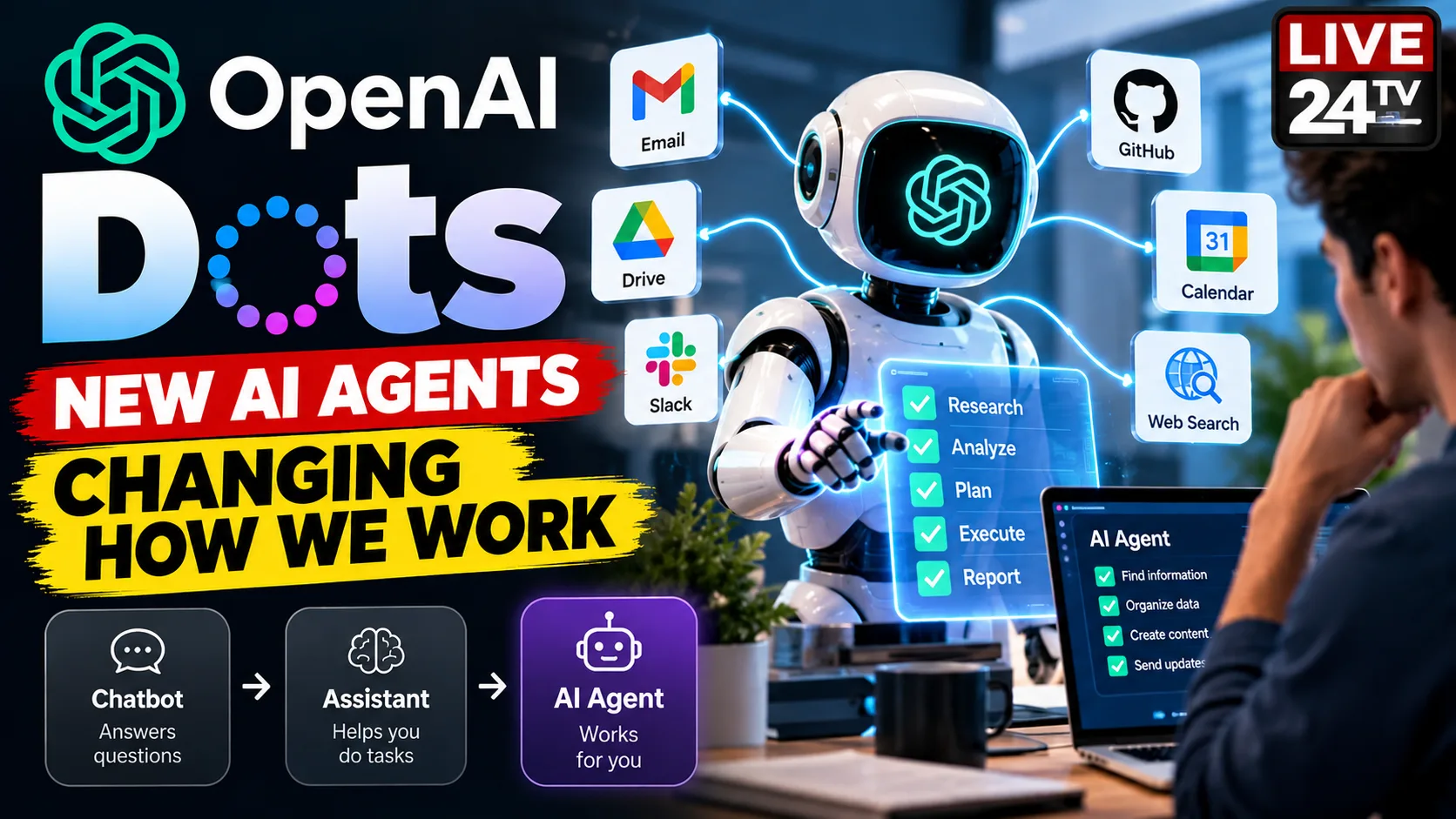
OpenAI Dots Launch: What Are AI Agents and How Will They Change the Way We Work?
OpenAI Dots is bringing a new idea to the AI industry: instead of using artificial intelligence only to answer questions, users can give AI an ongoing task and allow it to work on that task with connected tools.
The launch comes at a time when the technology industry is rapidly moving from traditional chatbots toward AI agents that can plan tasks, use software, access information and complete multi-step workflows.
For users, the biggest change is simple: AI is moving from something you talk to into something that can potentially work alongside you.
What Are OpenAI Dots?
OpenAI Dots are designed around the idea of persistent AI agents.
A traditional chatbot usually waits for a user to send a prompt. You ask a question, receive an answer and then decide what to do next.
Dots are designed for a different workflow.
Instead of giving the AI every individual instruction, a user can give it a broader objective. The AI can then work through multiple steps to move toward that objective.
For example, instead of repeatedly asking an AI to research competitors, a business owner could give an agent an ongoing responsibility to monitor competitors, collect relevant information and prepare updates.
This is one of the main ideas behind agentic AI.
OpenAI Dots vs Traditional Chatbots
The difference becomes easier to understand with a simple example.
A traditional chatbot works like this:
Question → Answer → Next Question
An AI agent works more like this:
Goal → Planning → Actions → Results → Human Approval
This does not mean that the AI should make every decision independently.
Instead, the goal is to allow AI to handle more of the repetitive steps while keeping humans involved when important decisions or sensitive actions are involved.
How Do OpenAI Dots Work?
The concept behind Dots combines several technologies.
First, there is the underlying AI model that provides reasoning and language capabilities.
Then there is the agent environment, where the AI can interact with software, information and other tools.
This allows an agent to perform a series of actions instead of simply generating text.
For example, a business task could involve:
Finding information.
Reading relevant documents.
Comparing different sources.
Organizing the information.
Preparing a report.
Sending the report for human review.
The important difference is that these steps can be connected into one workflow.
OpenAI Dots and Connected Apps
One of the most important parts of AI agents is their ability to work with external applications.
Modern businesses use many different platforms every day.
Teams may communicate through Slack or Microsoft Teams. Documents may be stored in Google Drive. Developers may use GitHub. Meetings may be managed through calendars.
An AI agent becomes significantly more useful when it can work across these environments with appropriate permissions.
For example, imagine a software company receives a customer complaint.
An AI agent could potentially identify the complaint, search relevant project information, investigate the issue and prepare a summary for the engineering team.
The agent could then wait for human approval before taking an important action.
This is very different from simply asking a chatbot, “How should we solve this problem?”
Why Are AI Agents Becoming So Important?
The AI industry has spent the last few years making models better at understanding and generating information.
The next challenge is making AI useful inside real workflows.
Businesses do not simply need an AI that can write a paragraph.
They need systems that can help them complete actual work.
That could include:
Market research
Customer support
Software development
Data analysis
Content creation
Documentation
Project management
Business reporting
Internal research
AI agents are designed to connect these individual tasks into larger workflows.
OpenAI Dots for Businesses
Small businesses could potentially benefit significantly from this type of technology.
A startup may not have separate employees for research, marketing, analytics and operations.
An AI agent could help with some of the repetitive digital work involved in these areas.
For example, a founder could have one workflow focused on market research and another focused on customer feedback.
Instead of manually collecting information every day, the AI could organize the information and provide a summary.
The human team could then spend more time making decisions and executing important business strategies.
OpenAI Dots for Developers
Software development is another area where AI agents could become particularly useful.
Developers already use AI for coding, debugging and documentation.
Agents take the concept further by potentially connecting several stages of the development process.
For example:
Issue → Code investigation → Proposed solution → Code changes → Testing → Report
Instead of asking AI to write one function at a time, developers can potentially give it a larger engineering task.
However, software changes still need appropriate testing and human review, especially when they affect production systems.
OpenAI Dots for Content Creators
Content creators could also use AI agents for repetitive parts of the content process.
Imagine giving an agent a weekly responsibility:
“Find important AI and technology developments and prepare potential content ideas.”
The workflow could include:
Research → Topic selection → Background information → Script ideas → Titles → Social media content
This could reduce the amount of repetitive research required before creating content.
The creator would still decide which story is worth publishing and how it should be presented.
The Biggest Challenge: AI Safety
More autonomy also means more risk.
If an AI only provides information, the user can review the answer before doing anything with it.
But if an AI can take actions, mistakes can have real consequences.
For example, an incorrectly configured agent could potentially:
Send the wrong message.
Modify the wrong document.
Make an incorrect software change.
Access information it does not need.
Share sensitive information.
This is why permissions are one of the most important parts of agentic AI.
Human Approval Still Matters
The future of AI agents is unlikely to be about giving AI unlimited control.
A more practical model is to divide actions into different permission levels.
Low-risk tasks can be automated.
Medium-risk tasks can require confirmation.
High-risk actions can remain under strict human control.
For example, an AI might automatically prepare an email but require the user to approve it before sending.
Similarly, an agent could prepare a software change but require a developer to review it before deployment.
This approach keeps humans involved where the consequences are more serious.
Privacy and Data Access
AI agents also raise important questions about privacy.
The more applications an AI can access, the more useful it can become.
But that access also increases the amount of sensitive information that the AI could potentially see.
Businesses therefore need to think carefully about:
Which applications an agent can access.
What information it can read.
What actions it can perform.
Which actions require approval.
How long information is retained.
Who can manage the agent.
The future of AI agents will depend not only on intelligence but also on strong security and permission systems.
OpenAI Dots and the Future of AI Agents
The bigger story behind Dots is the shift from generative AI to agentic AI.
Generative AI mainly creates content.
Agentic AI is designed to pursue a goal and perform actions using available tools.
That difference could have a major impact on software.
Today, people open applications and perform tasks manually.
In the future, users may simply describe the result they want.
For example:
“Prepare this week's business report.”
Instead of opening multiple applications and collecting information manually, an AI agent could potentially gather the required data, analyze it and prepare the report.
The user would then review the final result.
Could AI Agents Replace Human Employees?
The more realistic question is not whether AI will replace every human employee.
The important question is which tasks AI agents can perform reliably.
Repetitive digital tasks are likely to be among the easiest areas to automate.
Human judgement, creativity, leadership, relationships and accountability remain much harder to automate completely.
This means the workplace may gradually become a combination of human employees and AI agents working together.
A small team could potentially manage more work with the help of AI, while humans remain responsible for important decisions.
What Makes OpenAI Dots Different?
The important idea behind Dots is persistence.
Instead of treating AI as something that is used only when a user opens a chat, the agent can be designed around an ongoing responsibility.
That creates a different relationship between humans and AI.
You are no longer simply asking:
What can AI tell me?
You are starting to ask:
What work can AI take responsibility for?
That question could become one of the most important questions in the next stage of artificial intelligence.
The Future of AI Is Becoming More Agentic
OpenAI Dots are part of a much larger industry trend.
AI companies are increasingly developing systems that can browse, use computers, interact with applications, analyze information and complete multi-step tasks.
The competition is therefore moving beyond simply building a smarter chatbot.
The next stage will be about building AI that is:
Useful. Reliable. Secure. Autonomous when appropriate.
For users, that could mean spending less time performing repetitive computer tasks.
For businesses, it could mean new ways of organizing teams and workflows.
And for developers, it could mean building applications where AI agents become an active part of the product rather than simply a chatbot sitting inside it.
Final Takeaway
OpenAI Dots represent an important direction in the evolution of artificial intelligence.
The technology is moving from AI that answers questions toward AI that can help complete real-world digital work.
There are still major challenges around reliability, privacy, security and human control.
But the basic idea is powerful.
Instead of telling AI what to do at every step, users could increasingly give AI a goal and allow it to handle the work within clearly defined boundaries.
That could change how we use computers, how businesses operate and how people interact with software.
The chatbot era made AI conversational.
The agent era could make AI action-oriented.
And OpenAI Dots are part of that transition.